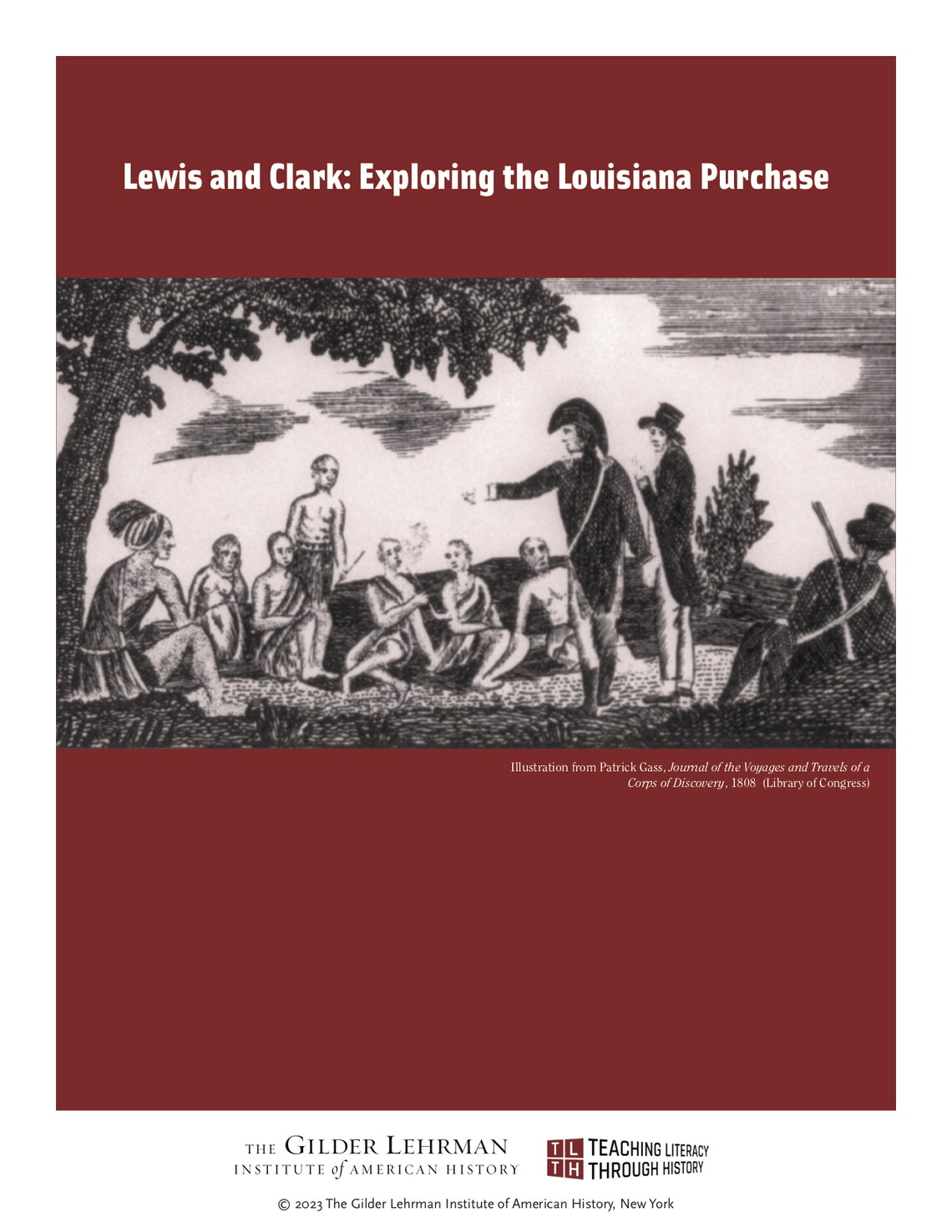
The Louisiana Purchase
Background
President Thomas Jefferson believed that the United States should be a nation of independent farmers. When France offered to sell the Louisiana Territory to the United States in 1803, Jefferson wanted to seize the opportunity to double the size of the nation and to provide future generations with a seemingly inexhaustible supply of new farmland. But Jefferson was a strict constructionist—he believed that the federal government had no powers other than those specifically listed in the Constitution—and the Constitution did not authorize the president to buy territory from foreign nations. The problem of Louisiana forced Jefferson to decide which principle was more important.
Materials
- Document 1: Notes on the State of Virginia. Query XIX: “Manufactures.” (PDF)
- Document 2: Letter to To Robert R. Livingston (PDF)
- Document 3: “Letter to John Breckinridge” (PDF)
- Document 4: “Message of the President of the United States, Transmitting a Treaty Lately Concluded Between the United States and the Kaskaskia Tribe of Indians.” (PDF)
- Document 5: A Treaty between the United States of America, and the Kaskaskia Tribe of Indians (PDF)
Procedure
Divide students into groups and provide them with documents and relevant questions related to the Louisiana Purchase. Group members should analyze the documents, answer the questions, and prepare a presentation using one or more of the following activities: role playing, panel discussion, debate, or artistic (e.g. political cartoon) or theatrical interpretation.
Group I – Jeffersonian Philosophy (Economic Systems)
Document 1: Notes on the State of Virginia. Query XIX: “Manufactures.”
Questions
- Compare Jefferson’s concepts of agrarian and industrial societies.
- How does the statement “The plough is to the farmer what the wand is to the sorcerer” reflect Jefferson’s concept of an agrarian society?
- How does Jefferson’s agrarian philosophy relate to the Louisiana Purchase?
- Did Jefferson’s agrarian philosophy justify the Louisiana Purchase?
- Based on your analysis, should Jefferson have purchased Louisiana in 1803?
Group II – Geopolitical Significance of Louisiana
Document 2: Letter to To Robert R. Livingston
Questions
- Locate New Orleans on a map. Who owned New Orleans prior to 1803?
- Why was New Orleans both important and dangerous to the United States?
- If you were Jefferson, how would you deal with this crisis?
- Would this decision be in the best interest of the United States?
Group III – Constitutionality of Purchase
Document III: “Letter to John Breckinridge”
Questions
- Does Jefferson retreat from strict construction in his purchase of Louisiana?
- List four key issues Jefferson must confront when considering the purchase of the Louisiana Territory.
- Describe Jefferson’s plan for obtaining congressional approval.
Group IV – Impact on the Native Americans
Document IV: “Message of the President of the United States, Transmitting a Treaty Lately Concluded Between the United States and the Kaskaskia Tribe of Indians.”
Questions
- What stipulations were specifically given to the women and children of the Kaskaskia Tribe?
- How were religious practices emphasized in the treaty?
- What factor affected the movement of the Kaskaskia from the Southwest to lands east and northeast of the Mississippi River?
Group Discussion
- Was the Louisiana Purchase a bargain or a burden?
- Today Americans can hop in a car or fly by plane coast to coast in the continental United States. Laws, currency, language, and individual rights flow freely throughout this domain. In other parts of the world, people must exchange currency, observe different laws, and speak different languages as they travel across their continents. If different nations controlled the territory between the Atlantic and Pacific Oceans, how would life be different today?
- Imagine that our president has just been offered the opportunity to buy the Maritime Provinces (New Brunswick, Nova Scotia, Newfoundland, and Prince Edward Island) from Canada. Should he accept the offer? What are the advantages and disadvantages of such an acquisition? How would this differ from the Louisiana Purchase in 1803?
Homework Assignment
Choose one of the following topics for a short essay:
- Write an editorial for a Federalist (anti-Jefferson) newspaper stating your position on the Louisiana Purchase.
- Write an essay describing the goals and achievements of the Lewis and Clark expedition.
- Describe the impact of the Louisiana Purchase on Native Americans.
- Assume the role of a resident of New Orleans. How would you react to the Louisiana Purchase?
Metadata
Make Gilder Lehrman your Home for History
Already have an account?
Please click here to login and access this page.
How to subscribe
Click here to get a free subscription if you are a K-12 educator or student, and here for more information on the Affiliate School Program, which provides even more benefits.
Otherwise, click here for information on a paid subscription for those who are not K-12 educators or students.
Make Gilder Lehrman your Home for History
Become an Affiliate School to have free access to the Gilder Lehrman site and all its features.
Click here to start your Affiliate School application today! You will have free access while your application is being processed.
Individual K-12 educators and students can also get a free subscription to the site by making a site account with a school-affiliated email address. Click here to do so now!
Make Gilder Lehrman your Home for History
Why Gilder Lehrman?
Your subscription grants you access to archives of rare historical documents, lectures by top historians, and a wealth of original historical material, while also helping to support history education in schools nationwide. Click here to see the kinds of historical resources to which you'll have access and here to read more about the Institute's educational programs.
Individual subscription: $25
Click here to sign up for an individual subscription to the Gilder Lehrman site.
K-12 School subscription: $195
Click here to sign up for an institutional subscription, which allows site access to all faculty and students in a single school, or all visitors to a library branch.
Make Gilder Lehrman your Home for History
Upgrade your Account
We're sorry, but it looks as though you do not have access to the full Gilder Lehrman site.
All K-12 educators receive free subscriptions to the Gilder Lehrman site, and our Affiliate School members gain even more benefits!
How to Subscribe
K-12 educator or student? Click here to edit your profile and indicate this, giving you free access, and here for more information on the Affiliate School Program.
Not a educator or student? Click here for more information on purchasing a subscription to the Gilder Lehrman site.
Related Site Content
- EssayAbraham Lincoln and Jacksonian Democracy
- MultimediaAlexander Hamilton
- MultimediaAlexander Hamilton, American
- MultimediaAmerican Scripture: The Making of the Declaration of Independence
- MultimediaAmerican Sphinx: The Character of Thomas Jefferson
- EssayAvast! How the US Built a Navy, Sent in the Marines, and Faced Down the Barbary Pirates
- Teaching ResourceConflict over Ratifying the Constitution
- Primary SourceDeclaration of Independence, 1776
- MultimediaDred Scott and the Constitutionality of Slavery
- MultimediaEmpire of Liberty: A History of the Early Republic
Add comment