Hamilton, Alexander (1755-1804) to Francois Marquis de Barbe-Marbois
High-resolution images are available to schools and libraries via subscription to American History, 1493-1943. Check to see if your school or library already has a subscription. Or click here for more information. You may also order a pdf of the image from us here.
A high-resolution version of this object is available for registered users. LOG IN
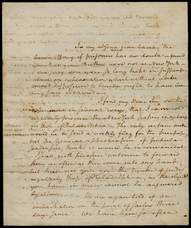
Gilder Lehrman Collection #: GLC00012 Author/Creator: Hamilton, Alexander (1755-1804) Place Written: Preakness, New Jersey Type: Autograph letter signed Date: 12 October 1780 Pagination: 2 p. : address ; 23 x 19 cm Order a Copy
To Marbois, the secretary of the French Ambassador, who later served as Intendent of Santo Domingo and minister of finance under Napoleon, under whom he sold Louisiana to the U.S. Hamilton concludes his letter by agreeing with Marbois about America's "feebleness and temporary expedients" in military affairs; and notes that he views "our affairs in a gloomy light." Hamilton ends by mentioning rumors of a peace congress by the neutral powers at the Hague. (This may refer to the attempt by Catherine of Russia to mediate the dispute.) Place of writing supplied from Hamilton Papers.
Notes: Syrett, Papers of Alexander Hamilton, 2: 471-72. Hamilton had written to Barbé-Marbois 17 August concerning obtaining the release from prison of Barbé-Marbois's brothers. Compare Hamilton to Milton's description of Hell in Paradise Lost 1. 62-64: "…yet from those flames / No light, but rather darkness visible / Serv'd only to discover sights of woe…."
Signer of the U.S. Constitution.
In my absence from Camp, the Commissary of Prisoners has no doubt informed you, that your Brothers were not at New York - I am sorry you were so long kept in suspense about an explanation which without a determined disposition to blunder ought to have been long since obtained -
I find, my Dear Sir, on the experiment in several ways, that I cannot regularly procure the New York papers in exchange for those of Philadelphia - The only certain mode would be to send a weekly flag for the purpose, but the General apprehensive of popular jealousies, thinks it would inconvenient. - I shall with pleasure continue to forward them as often as they come into my hands; but I will not give you the trouble of sending regularly those of Philadelphia, as the object you have in view cannot be answered by it -
We are again told of an embarkation on the point of sailing three days since. We have been so often [2] deceived that we are diffident of accounts of this kind; but the present come with a
degree of emphasis, that entitle them to attention - No [inserted: particulars] The want of money makes us want every thing else - even [struck: alle] intelligence.
I have received since my [struck: let] return several letters from you - I agree with you my Dear Sir that while we call to our friends for help, we ought to help ourselves; and I am mortified that we seem not to be in a disposition to do it - The late deliberations on our military affairs prove that we have not profitted by experience; - Still the same system of feebleness and temporary expedients.
Misfortune may at last [struck: make illegible] enlighten us; but it may [inserted: come too late to do any thing more] [strikeout] than to make our "darkness visible" and discover to us "sights of woe" - I confess I view our affairs in a gloomy light - We hear there is to be a Congress of the neutral powers to meet at the hague this winter to mediate a peace - God send it - we want one.
Permit me to repeat to you the assurances of my attachment.
A Hamilton
October 12th. 80
[address leaf]
Mr. De Marbois
Secretary of Embassy to
his most Christian
Majesty &c. &c.
Philadelphia
Citation Guidelines for Online Resources
The copyright law of the United States (title 17, United States Code) governs the making of photocopies or other reproductions of copyrighted material. Under certain conditions specified in the law, libraries and archives are authorized to furnish a photocopy or other reproduction. One of these specific conditions is that the photocopy or reproduction is not to be “used for any purpose other than private study, scholarship, or research.” If a user makes a request for, or later uses, a photocopy or reproduction for purposes in excess of “fair use,” that user may be liable for copyright infringement. This institution reserves the right to refuse to accept a copying order if, in its judgment, fulfillment of the order would involve violation of copyright law.